
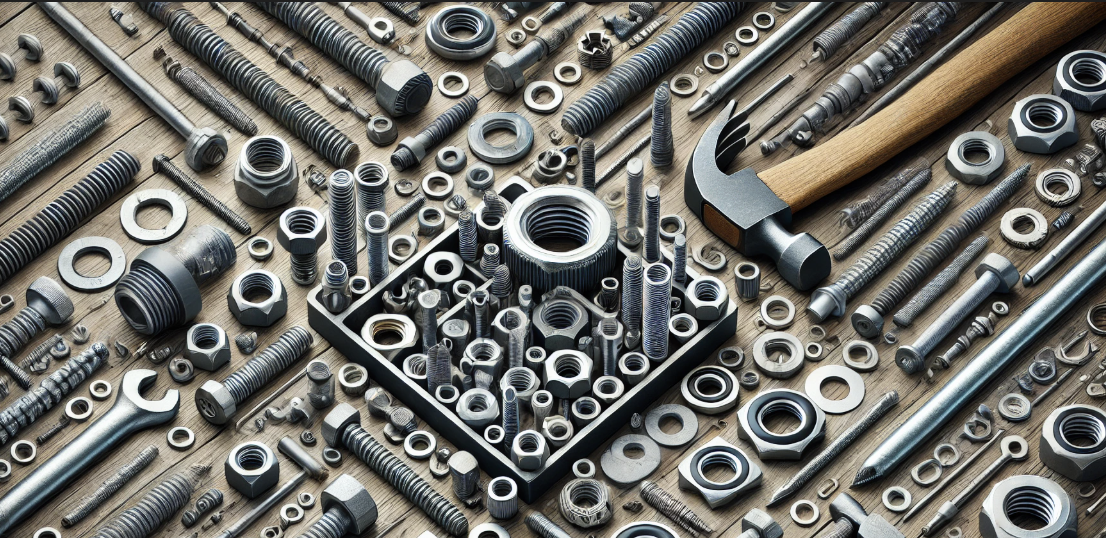
When we look at a towering skyscraper, a suspension bridge stretching across a bay, or a high-speed train zooming past, we usually marvel at the grand engineering. We see the steel beams, the concrete pillars, and the aerodynamic designs. What we rarely notice are the thousands of tiny components holding it all together.
Secure fastening is the unsung hero of modern infrastructure. It is the invisible force that ensures a bridge doesn’t buckle under high winds and that a pipeline doesn’t leak under pressure. While architects and lead engineers get the accolades, the integrity of our built environment often comes down to the reliability of bolts, screws, anchors, and nuts.
In this post, we’ll explore why these seemingly minor details are actually the most critical aspect of public safety and structural longevity, and why cutting corners on fastening can lead to catastrophic results.
The Consequences of Loosening
To understand the importance of secure fastening, we first have to look at what happens when it fails. Fastening failure isn’t just about a wobbly table leg; in infrastructure, the stakes are life and death.
Vibration is the arch-nemesis of any fastened joint. Cars driving over a bridge, wind buffeting a solar panel array, or the constant hum of machinery in a factory all create vibrations. Over time, these vibrations can cause fasteners to self-loosen. This phenomenon, often investigated in engineering forensics, can lead to structural instability.
Historical infrastructure failures often trace back to a single point of weakness. A bolt that sheared off because it wasn’t the right grade, or a nut that vibrated loose because it lacked a locking mechanism, can trigger a chain reaction. When one fastener fails, the load it was carrying is redistributed to neighboring points, potentially overloading them and causing a cascade of failures.
Types of Secure Fastening in Heavy Industry
Different structures require different fastening strategies. You wouldn’t use wood glue to hold a steel beam, and similarly, standard hardware store bolts aren’t enough for heavy infrastructure.
Tension Control Bolts
In steel construction, tension control bolts are ubiquitous. These are designed to be installed with a specific amount of torque, ensuring the clamping force is exactly what the engineers calculated. They often have a splined end that shears off once the correct tension is reached, providing a visual confirmation that the bolt is secure.
Chemical Anchors
For attaching steel to concrete—like securing a highway railing to the road deck—mechanical expansion anchors or chemical anchors are used. Chemical anchors use a resin that hardens and bonds the metal stud to the concrete, creating a connection that is often stronger than the concrete itself.
Specialized Hardware
In situations requiring extreme durability and load-bearing capacity, engineers turn to specific components like the heavy hex nut. Unlike a standard nut, this component is slightly larger and thicker, providing a greater bearing surface and thread engagement. This makes it ideal for high-pressure environments where maintaining clamping force is non-negotiable, such as in petrochemical plants or major structural steel connections. Using a heavy hex nut ensures that the connection can withstand higher temperatures and pressures without deforming.
The Role of Maintenance and Inspection
Even the best fastening systems aren’t “set it and forget it.” Infrastructure ages, and environmental factors play a massive role in the longevity of a joint.
Corrosion is a major threat. Saltwater spray on coastal bridges or de-icing salts on winter roads can eat away at steel fasteners. Rust causes the metal to expand, which can crack the surrounding material or simply cause the fastener to lose its grip.
Regular inspection routines are vital. Inspectors use various methods, from simple visual checks to ultrasonic testing, to ensure bolts are still tight and free of cracks. In critical infrastructure, smart sensors are increasingly being used to monitor tension in real-time, sending an alert to maintenance crews if a bolt begins to loosen.
Safety Factors and Redundancy
Engineers never design a structure to handle exactly the load it’s expected to carry. They design for much more. This is known as the “factor of safety.”
If a walkway is expected to hold 100 people, the fastening system might be designed to hold 300. This buffer accounts for unexpected events—like a sudden stampede or an unusually strong gust of wind.
Redundancy is another key concept. Secure fastening often involves using more fasteners than mathematically necessary. If a connection needs four bolts to be secure, an engineer might specify six or eight. This way, if one bolt fails due to a manufacturing defect or unforeseen damage, the remaining bolts can pick up the slack without the structure collapsing.
The Future of Fastening
As our infrastructure evolves, so does the technology holding it together. We are moving toward smarter, more resilient cities, and fastening technology is keeping pace.
Innovations include self-healing coatings that prevent corrosion even if the surface is scratched, and “memory metal” alloys that can tighten themselves in response to temperature changes. There is also a push toward more sustainable materials, reducing the carbon footprint of producing the millions of steel fasteners used annually.
Furthermore, the rise of modular construction—where building parts are assembled in a factory and then bolted together on-site—places even more emphasis on the precision and quality of fasteners. In this method, the connections are the structure.
Building a Safer Tomorrow
It is easy to overlook the bolts and anchors that dot our daily landscape. They are painted over, hidden behind panels, or simply too small to catch the eye against the backdrop of massive steel beams. Yet, secure fastening is the bedrock of reliable infrastructure.
From the specialized heavy hex nut keeping a high-pressure valve sealed to the thousands of rivets on an airplane wing, these components carry the weight of our modern world. Prioritizing high-quality materials, proper installation, and regular maintenance ensures that our bridges stay standing, our trains run on time, and our public spaces remain safe for everyone. The next time you cross a bridge, take a moment to appreciate the grip of the humble fastener—it’s doing a lot of heavy lifting.
